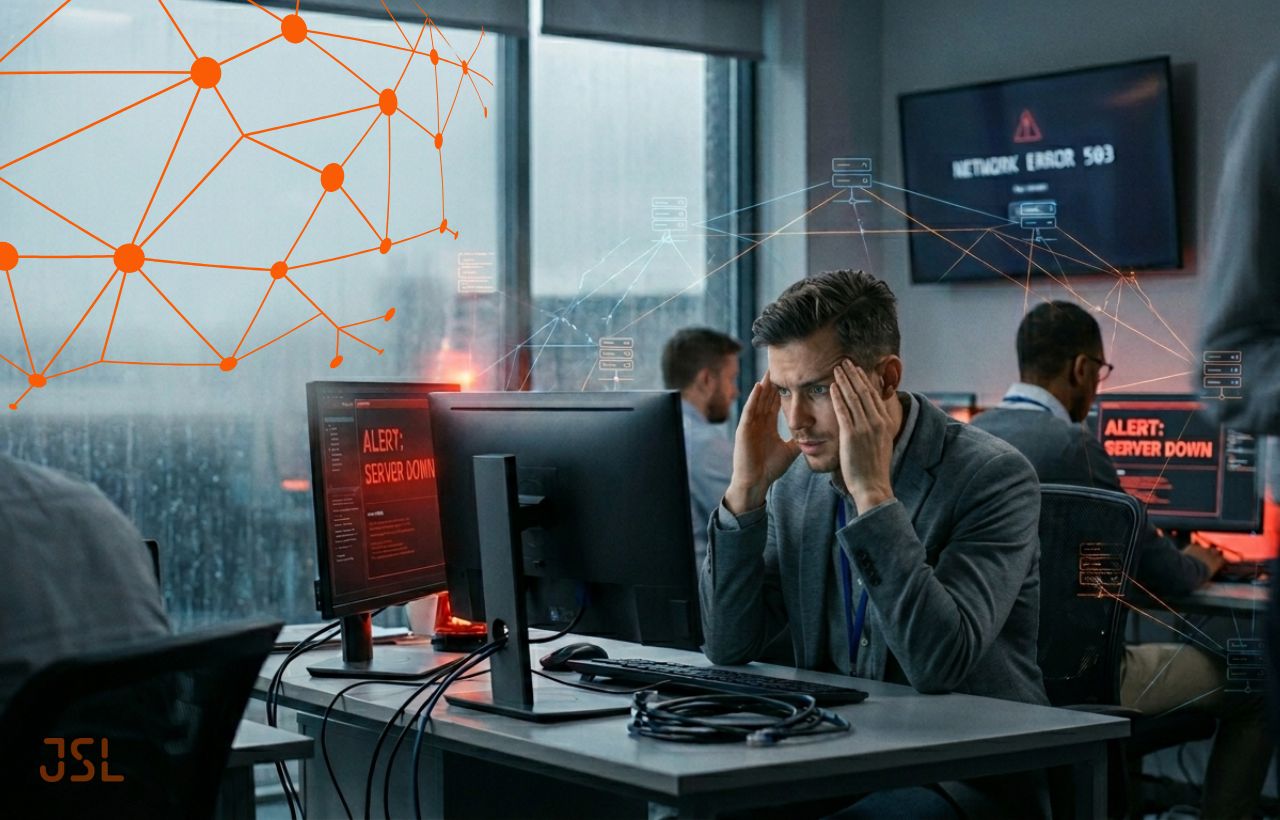
From village schools to multi-site federations we have services adjusted to your needs, meaning you can be teaching our next generation secure in the knowledge we have it covered!
Your work is more important than worrying about IT issues, we have a fully adaptable range of services to make sure your focus remains on the task at hand!
Safeguarding, Security and IT: Why Schools Need Joined-Up Thinking
JSL Services
Introduction
Schools rely on technology more than ever before.
From classroom learning and administration to safeguarding systems, communications, and cloud-based platforms, technology plays a central role in supporting both staff and students.
At the same time, schools face increasing responsibilities around safeguarding, cyber security, data protection, and operational resilience.
These challenges are often managed separately. Safeguarding sits with one team, IT with another, and compliance with someone else entirely.
But in practice, they are closely connected.
When technology, security, and safeguarding are viewed as separate issues, gaps can appear. And in education environments, those gaps can have wider consequences than many organisations realise.
When safeguarding becomes more than a policy
Safeguarding is often associated with policies, procedures, and staff responsibilities.
While these remain essential, modern safeguarding increasingly depends on technology too.
Schools rely on systems that help:
Monitor and filter internet access
Protect student information
Support online learning
Manage communication between staff, parents, and students
Detect and respond to potential safeguarding concerns
When these systems are poorly managed, outdated, or disconnected, safeguarding becomes harder to maintain consistently.
Technology may not replace safeguarding processes, but it plays an important role in supporting them.
Resources from the UK Safer Internet Centre help schools connect safeguarding policies with practical online safety guidance for staff and students.
NSPCC online safety guidance supports the need for schools to combine policy, staff awareness, and technology controls to help keep children safer online.
The growing cyber security challenge for schools
Schools have become attractive targets for cyber criminals.
They often hold large amounts of personal data, operate under budget pressures, and manage a wide variety of devices and users across different locations.
Common challenges include:
Managing access for staff, students, and third parties
Protecting sensitive student and employee information
Keeping devices updated and secure
Managing cyber security awareness across the organisation
Responding quickly when incidents occur
A cyber incident can affect far more than systems. It can disrupt teaching, administration, communication, and trust.
In education, cyber security isn't just about protecting technology — it's about protecting the people who rely on it.
The operational pressures schools face every day
Many schools operate with limited internal IT resources.
Staff are balancing teaching, administration, safeguarding responsibilities, inspections, compliance requirements, and day-to-day operational demands.
When technology issues occur, the impact is often immediate:
Lessons may be disrupted
Administrative tasks take longer
Communication becomes more difficult
Staff spend time troubleshooting rather than focusing on students
Even relatively small issues can create unnecessary pressure in already busy environments.
This is why reliability matters just as much as security.
What joined-up thinking looks like in practice
The most effective schools don't view safeguarding, cyber security, and IT support as separate conversations.
Instead, they take a joined-up approach.
This often includes:
Secure and well-managed IT infrastructure
Appropriate web filtering and monitoring
Clear cyber security controls and user access management
Reliable connectivity across the school environment
Staff training and awareness programmes
Regular reviews of systems, risks, and safeguarding requirements
When these elements work together, schools are better positioned to protect students, support staff, and maintain continuity.
At JSL, we understand that schools face unique challenges.
Safeguarding, cyber security, connectivity, compliance, and day-to-day IT support all need to work together to support a safe and effective learning environment.
We work with schools, federations, charities, and SMEs to provide joined-up support across IT, cyber security, cloud services, communications, and compliance.
Our focus is on helping schools reduce risk, improve reliability, and create technology environments that genuinely support staff and students.
That means practical advice, clear communication, and long-term partnership — not unnecessary complexity.
Conclusion
Technology plays a vital role in modern education.
But safeguarding, security, and IT cannot be viewed in isolation.
Schools that take a joined-up approach are often better equipped to protect students, support staff, manage risk, and respond confidently when challenges arise.
The goal isn't simply to have secure systems. It's to create an environment where technology actively supports safeguarding, teaching, learning, and day-to-day operations.
If you're unsure whether your current technology setup fully supports your safeguarding and security objectives, a fresh review can provide valuable clarity.
If you need support reviewing your school's IT, cyber security, connectivity, or safeguarding-related systems, JSL is here to help.
That's why we offer a Free IT & Cyber Health Audit— a straightforward way to assess your current environment, identify potential risks, and understand where practical improvements could make the biggest difference
About JSL Group
Since 2003, JSL has been supporting Buckinghamshire businesses, schools, and charities with reliable IT support, managed services, and cybersecurity solutions. As a Microsoft Partner, our mission is to simplify IT so you can focus on what matters most.
Take the stress out of IT with a free, no-obligation audit.
Introduction
For many organisations, Cyber Essentials is seen as an important step towards improving cyber security.
Cyber Essentials is a government-backed scheme...
Introduction
Schools rely on technology more than ever before.
From classroom learning and administration to safeguarding systems, communications, and cloud-based platforms, technology...
Introduction
For many small and medium-sized organisations, GDPR can feel distant.
Something that applies to larger organisations, or something that was dealt...
Introduction
For most organisations, connectivity is simply expected to work.
Internet access, phones, Wi-Fi — they’re part of the background.Something staff rely...